

What Is Identity Fabric
“Identity Fabric” refers to a flexible framework or architecture that integrates and orchestrates diverse Identity & Access Management (IAM) systems—on-premises, cloud, legacy applications, customer-facing IAM, privileged identities, etc.—into a unified, cohesive identity layer. It isn’t a single product so much as a paradigm: identity silos (separate IAM solutions, directories, identity providers) are woven together through orchestrated identity workflows, shared policies, common tools for authentication, authorization, governance, and visibility.
Why Do We Need It
Modern organizations—especially those with hybrid, multi-cloud, legacy, and SaaS environments—face growing complexity in identity management. Disparate IAM systems lead to inconsistent security policies, poor user experience (multiple logins, inconsistent access), exposure to credential-based attacks, and challenges in compliance and auditing. An identity fabric helps reduce those risks by providing centralized policy enforcement, unified authentication mechanisms (e.g. MFA, passwordless), threat detection, and governance across all identity touchpoints. For public sector organizations, identity fabric aids in meeting regulatory requirements and ensuring transparency and accountability; for commercial entities, it helps with customer trust, operational efficiency, and reducing vendor lock-in.
Where It Helps
Identity fabric delivers value in multiple areas:
- Hybrid & multi-cloud environments: enables consistent identity and access policy enforcement across clouds and on-prem infrastructure.
- Legacy applications: allows older, non-standards-based apps to interoperate securely without complete rewrites.
- Customer and privileged identity management: simplifies management of external identities (CIAM) and internal elevated (“privileged”) accounts under the same fabric.
- Compliance, audit, and security hardening: unified logging, traceability, least-privilege access, and centralized oversight make it easier to respond to regulations, detect threats, and demonstrate accountability.
How to Implement
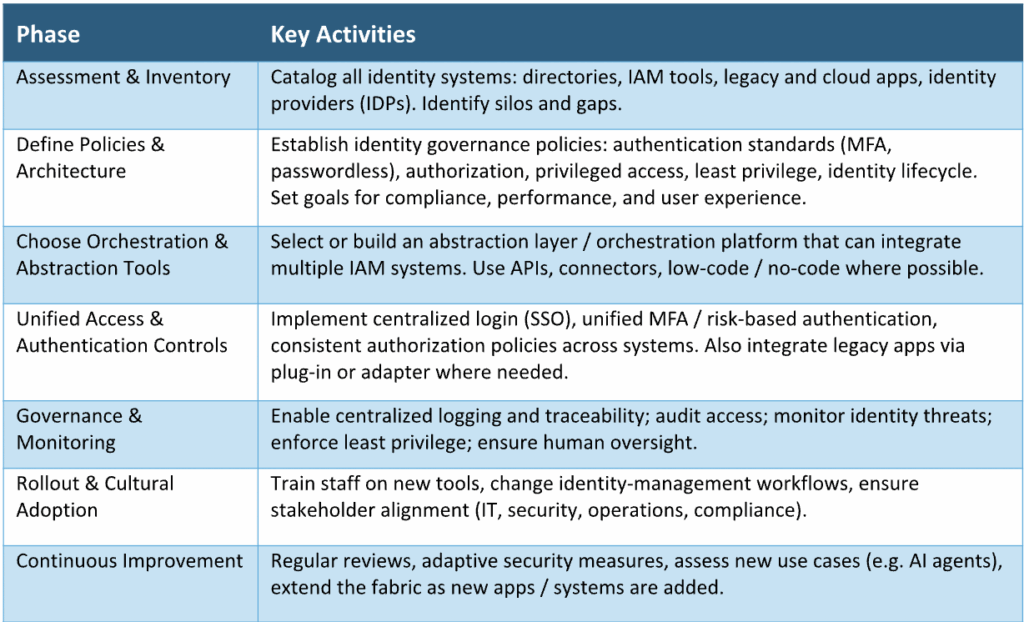
Implementing an identity fabric involves several key steps. Below is a suggested roadmap (adaptable to specific organizational scale and complexity).
Conclusion
Identity Fabric provides a strategic path forward for organizations needing to unify fragmented identity systems, increase security, and comply with evolving regulatory demands. When done right, it delivers improved user experience, lower risk, and greater operational agility. Whether public sector agencies or commercial enterprises, implementing identity fabric can be a transformational step toward resilient, secure, and efficient identity management.